





Wisdom Tooth Removal: When Is Surgery Actually Necessary?
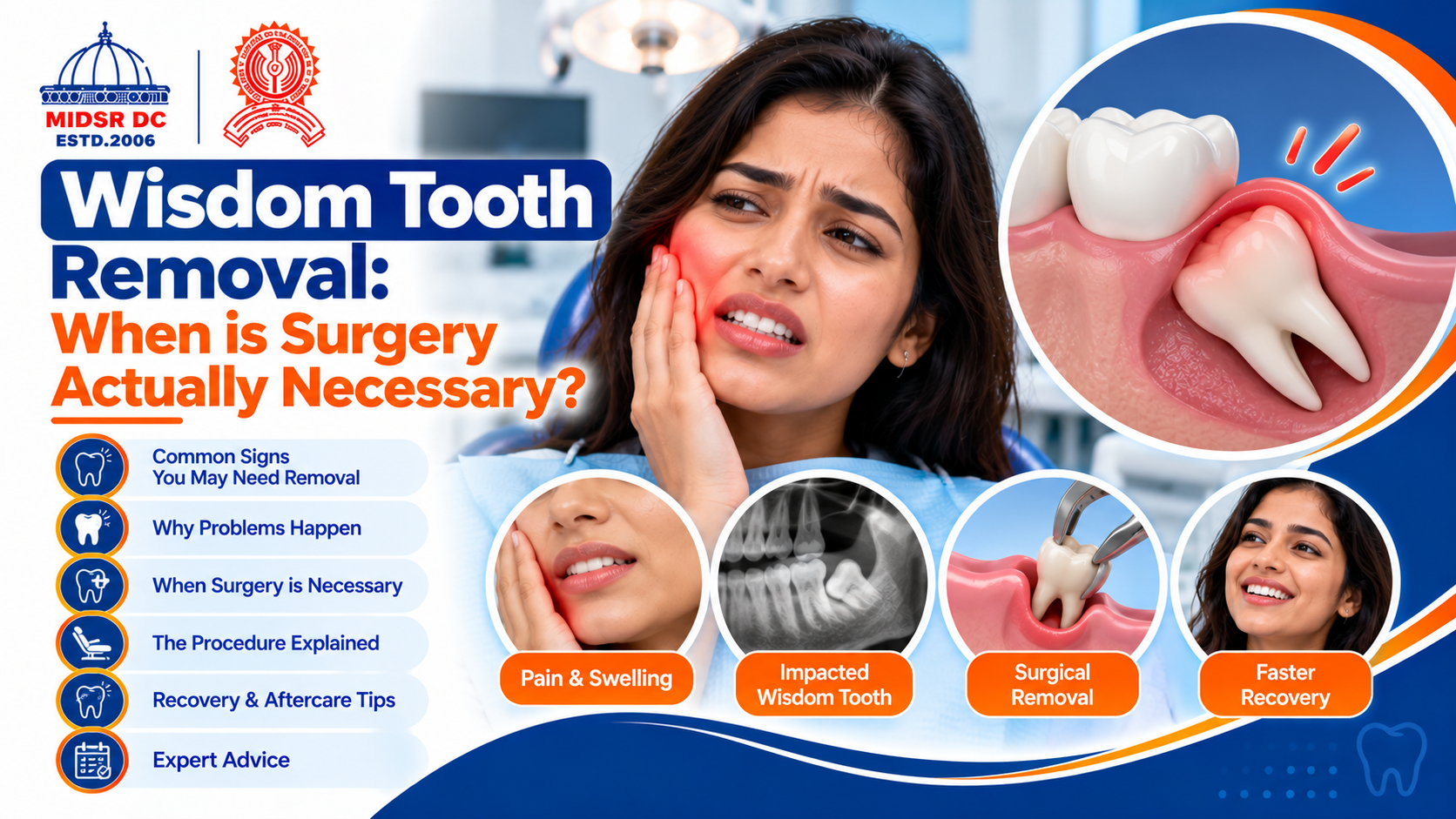
That strange ache in the back of your jaw is easy to ignore. But there may be no harm. Sometimes it is associated with wisdom teeth starting to cause problems, especially if you are covering the pain with painkillers.
Not all wisdom teeth need to be removed. But if you leave the problem alone for too long it can become a bigger job with the next steps.
Let’s start with the basics. We’ll go over the real signs of an infection and when to see a specialist.
Check Out: Top Dental Treatments Offered by MIDSR Dental College in Latur
Quick Reality Check: What are wisdom teeth?
Wisdom teeth, or third molars, usually appear between the ages of 17 and 25. At that point, many people just don’t have room in the jaw.
The teeth can get trapped when there is no room. They may be partially or completely in the gum or the bone. Dentists call this an impaction. Impacted wisdom teeth can lead to problems.”
7 Signs You Probably Need Surgery
If you're dealing with any of these, it's not "wait and see" territory anymore.
1. Pericoronitis (recurrent gum infections)
That swollen, sore flap of gum over a partially erupted tooth? That's the pericoronitis. It traps food particles and bacteria and pus.
What you will see:
Bad taste in mouth
Waves swelling
Pain when chewing or opening mouth
Swollen lymph nodes or fever occasionally
The numbers: Pericoronitis affects 6-10% of young adults. A 2026 Indian study reported it in 5.7% of impaction cases and it was most common in the 21–25 age group.
2. Cavities that are hard to handle
Wisdom teeth are tough to reach for daily cleaning. If you have decay on a wisdom tooth, or decay on the molar next to it, a filling alone may not solve the full problem.
3. Problems with front teeth
Impacted wisdom teeth can slowly destroy the root of the tooth in front, the second molar. In more than half the cases when nothing is done it is reported that the neighboring tooth gets hurt; You may not feel pain right away. But the risk can begin before you see it.
4. Fluid sacs near an unhidden tooth
When a wisdom tooth never comes in, a fluid pocket can form around it. Most of these are not cancer. Even so, they may grow and affect the jaw bone, the teeth nearby, and nearby nerves. Often, you will not see it at first. An X-ray is commonly how it gets found early.
5. Pain that keeps going or swelling
If pain medicine does not work the same as before, or if your jaw stays sore and feels tight for days, that is a key sign. It can mean your body is reacting to something wrong.
6. Food bits at the back and a bad smell
If you find food stuck behind your last molar time and again, this could be a sign of cleaning trouble. When people tell you that your breath still smells bad even after you brush, don’t ignore it.
7. Space needed for braces or other dental care
With braces, tight spacing can become a bigger issue. Many orthodontists recommend taking out wisdom teeth first. The goal is to make room and give the other teeth space to shift.
Read More: Affordable Dental Treatments in Latur
Emergency warning signs (go to a dental hospital right away)
Go to a dental hospital now if you notice any of these signs.
Do not wait.
- Very high fever along with jaw pain
- Pain or difficulty swallowing, or trouble breathing
- Large swelling on the face or in the neck
- Pus in the back area of the mouth
- Numb feeling in the lower lip, chin, or tongue
- You can open your mouth only about two fingers wide
Types of impacted wisdom teeth
Not all impactions are the same. Here's what dentists see most often:
Type | Position | How Common | Surgery Needed? |
Mesial (Mesioangular) | Tilted forward, pressing into the tooth in front | ~55% (most common in India) | Almost always |
Vertical | Upright but stuck under gum/bone | ~38% | Sometimes—if infected |
Horizontal | Lying flat, sideways in the jaw | ~5–15% | Yes—high risk |
Distal | Tilted backward | ~3–6% | Often—hardest to remove |
Fact: According to a 2025 study on Central India, 20.7% of dental patients had impaction.
India Statistics (2025-2026)
Most affected are in the age group 21-25 years old (40.8% of those affected)
Total 55.3 per cent of mesioangular impaction
Risk of pericoronitis: Vertical impaction is 2.83 times more dangerous than other types
Prevalence of impaction varies from 15% to 45% in the region based on the study
Cost in India (2026 Estimates)
Procedure | Price Range (per tooth) |
Simple extraction (fully erupted) | ₹2,000–₹5,000 |
Surgical extraction (soft-tissue impaction) | ₹5,000–₹10,000 |
Surgical extraction (bony impaction) | ₹8,000–₹15,000+ |
Sedation/general anesthesia (optional) | ₹5,000–₹15,000 extra |
How to Cooperate During the Visit
Share your medical history
Tell the dentist about allergies, existing health conditions, regular medicines and any previous reaction to anesthesia.
Follow pre-appointment instructions
Ask whether you should eat, drink or take your usual medicines before the procedure. Wear comfortable clothing and arrive on time.
Stay relaxed during the procedure
You will remain awake, so try to keep your body still and breathe normally. Inform the dentist immediately if you feel sharp pain or discomfort.
Follow the dentist’s instructions
Keep your mouth open as advised, avoid sudden movements and use hand signals if you need a short break.
Avoid touching the treatment area
Do not pull at stitches, bite the numb area or repeatedly check the wound with your tongue or fingers.
Follow aftercare advice carefully
Take prescribed medicines as directed, follow the recommended mouth-rinse routine and choose suitable foods during recovery. Contact your dentist if you experience severe pain, persistent bleeding, fever or swelling that worsens.
Time needed: Usually 20 to 45 minutes for one tooth. Many people are done in under an hour and go home.
Recovery: Day-by-Day
Day | What You'll Feel | What to Do |
Day 1 | Numbness wears off, mild bleeding, swelling starts | Ice packs, soft foods, rest |
Day 2–3 | Peak swelling, most discomfort | Warm saltwater rinses, pain meds |
Day 4–7 | Swelling goes down | Gentle brushing, normal activities |
Week 2 | Most pain gone | Back to regular diet |
Time for complete bone to heal: 3 to 6 months although in 1 to 2 weeks you may feel fine.
When You Can Keep Your Wisdom Teeth
You might be totally fine if:
It's fully erupted, straight, and you can chew with it
You can clean it properly (no constant food trapping)
No decay, gum disease, or cysts on X-ray
It's not damaging the tooth in front
No pain or recurrent infections
But: Even symptom-free impacted teeth should be checked yearly with X-rays.
Why pick MIDSR Dental College and Hospital?
MIDSR (the Maharashtra Institute of Dental Sciences and Research), is seen as one of the well-established dental hospitals in Latur. Services at the hospital include:
Oral and maxillofacial surgeons with daily experience in tough cases
Digital X-rays and CBCT scans to help with accurate plans
A modern operation room, with sedation and general anesthesia when needed
Prices that are lower than in metro cities
Care after treatment, plus help in case of an emergency
MIDSR also runs an MDS program in Oral and Maxillofacial Surgery. There are 5 seats each year. That means your treatment team focuses on these cases often.
📍 Address: Ambajogai-Latur Road, Kashilingeshwar Nagar, Latur, Maharashtra 413531
📞 Appointment: You can get an appointment by calling the hospital or by going there in person.
Try not to wait. If you feel tooth pain, get help early, before it gets worse or starts affecting other teeth.
Your wisdom teeth shouldn't be a wisdom problem. Get them checked before they get worse.
Frequently Asked Questions
Is there going to be any pain during the procedure?
No. Your body will be numb during the whole procedure. You may feel some pressure but not pain.
After how much time am I allowed to eat normally?
Generally, in a period of 5 to 7 days average people return to their regular diet.
Am I able to go work or college next day after that?
Take 2-3 days off. After two or three days the swelling reaches its maximum level.
I am scared of needles. Am I able to use sedation in the clinic?
Ask about sedation. There are clinics that offer you nitrous oxide or IV sedation.
Is it necessary to extract all wisdom teeth on the same day?
Not really, but extraction of all wisdom teeth saves time on several healing periods.