



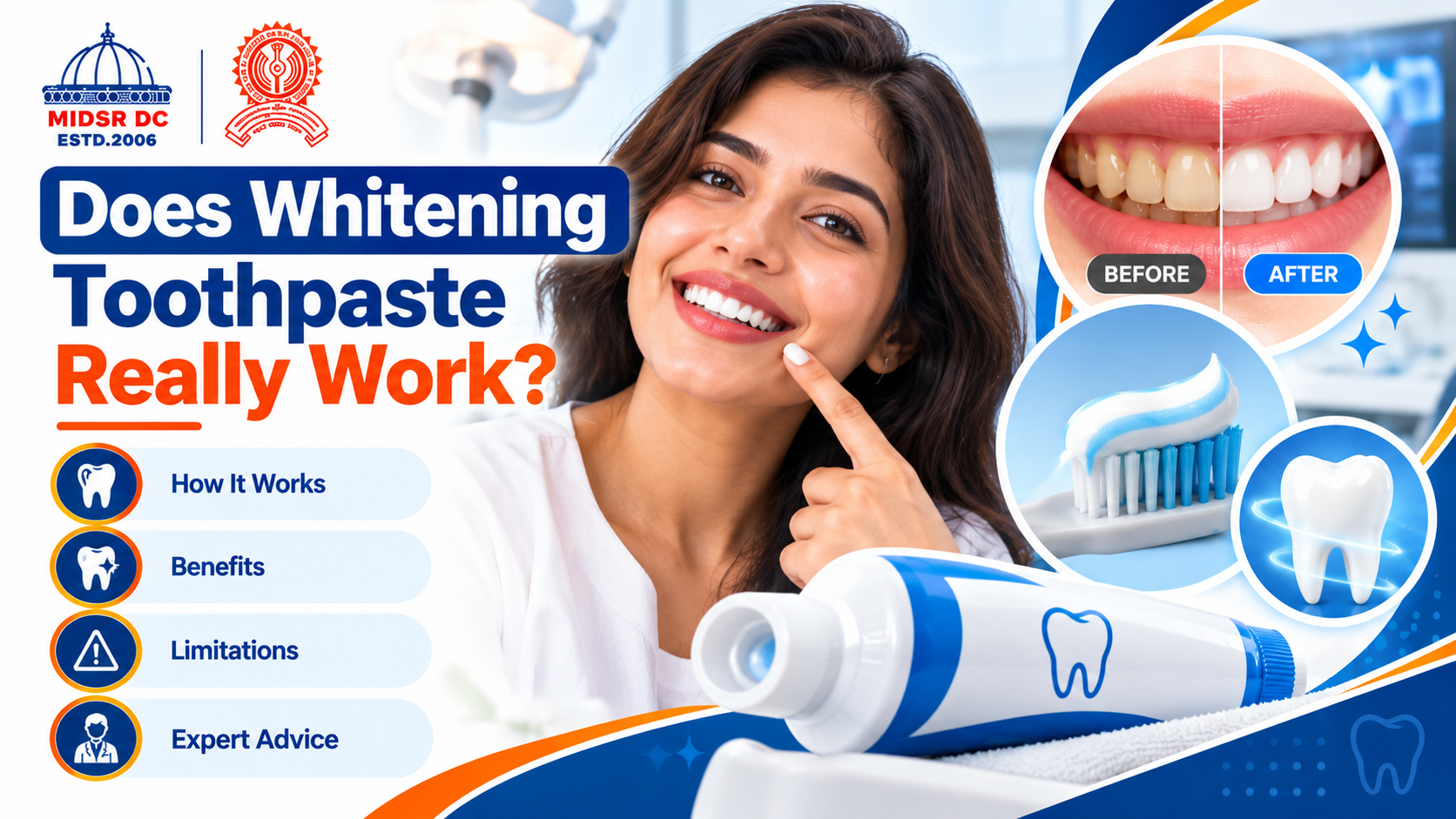
Have you ever bought a whitening toothpaste just because the label promises you something like a brighter smile, you know. I think most people do it at some point , at least once. Whitening toothpaste is probably one of the easiest and cheapest ways people try to make their tooth surfaces look more white, but the results are usually misunderstood.
So, does whitening toothpaste work? It kinda does, mostly for taking care of surface stains. But whitening toothpaste cannot swap places with professional bleaching, because it doesn’t alter the natural shade of teeth and it also doesn’t really touch internal staining.
Visit MITMIDSR Dental Hospital for a dental check-up.
What is whitening toothpaste, really?
Whitening toothpaste is basically a toothpaste kind that targets stains on your teeth. It works through several methods, sometimes at the same time.
1. Mild abrasives help “scrub” and polish stains away from the enamel outer layer.
2. A low amount of peroxide may lighten a few kinds of discoloration.
3. Optical brighteners create a short lived whitening illusion, so teeth appear brighter right away.
4. Anti-staining components aim to reduce how easily new stains stick later.
The American Dental Association says whitening toothpastes can be helpful for removing extrinsic stains, mainly due to abrasives, while some formulas may include a small bit of peroxide in their makeup.
What Stains Can It Remove?
Whitening toothpaste is most useful for extrinsic stains—discolouration that develops on the outer surface of the teeth.
Type of stain | Common causes | Can whitening toothpaste help? |
Surface or extrinsic stains | Tea, coffee, tobacco, red wine, cola and poor brushing | Usually, yes |
Intrinsic stains | Fluorosis, ageing, trauma and certain medicines | Usually, no |
Plaque-related yellow appearance | Inadequate brushing and plaque accumulation | It may improve appearance |
Discolouration from fillings, crowns or veneers | Tooth-coloured restorations | No, restorations do not whiten |
Tartar-related stains | Hardened plaque or calculus | No, professional cleaning is required |
What is the maximum whitening that can be achieved?
The answer is: the teeth are often only whitened slightly as opposed to radically.
Studies show that some whitening toothpaste can provide good results in about two to six weeks according to the formulas and regularity of their application. However, a clinical study with blue-covarine toothpaste revealed that its whitening effect was not different from that of normal toothpaste after two weeks and both toothpastes were inferior to other whitening procedures that can be done at home.
The reason for this discrepancy in results is that the products labeled with the term ‘whitening’ do not necessarily consist of the same components, have the same abrasive system or active concentrations.
Whitening toothpaste may help if:
Your teeth have coffee, tea or tobacco stains.
You want to maintain the results of professional whitening.
You brush twice daily with a soft-bristled toothbrush.
Your expectations are limited to stain removal and mild brightening.
When it comes to teeth whiteners, they might not be enough if:
If your teeth are naturally darker or yellow because of old age;
If you are suffering from fluorosis or staining from medications.
If there is a tooth that has darkened as a result of trauma or root canal treatment.
If you have crowns, veneers, or fillings that appear to be darker compared to your natural teeth;
If tartar, decay, or gum disease causes the change in color.
Is Whitening Toothpaste Safe?
Most people can use an effective fluoride whitening toothpaste properly. However, more whitening does not equal better whitening. A very abrasive product, aggressive brushing, or overuse of it may worsen enamel damage and expose yellower dentin beneath it.
Possible issues are:
Temporarily sensitive teeth.
Irritated gums.
More sensitive teeth from exposed roots or teeth that have experienced enamel damage.
Surface damage from fierce brushing or too much abrasive product.
Uneven coloration due to restorations.
Charcoal Toothpaste
Charcoal toothpaste may be popular, but being popular doesn’t mean it is safe. According to the ADA, there is little scientific proof showing that products containing charcoal are effective in terms of whitening.
Similarly, mixtures of lemon juice, vinegar, baking soda, etc. which can be made at home can also be abrasive or acidic. These substances can cause enamel damage and not be useful for whitening.
Tips on Choosing the Right Whitening Toothpaste
When looking for a whitening toothpaste, start with the following:
Look for fluoride: Whitening should not mean protection against cavities is gone.
Choose brands you know: Products claiming capabilities such as “whitening in one day” should be avoided.
Think about sensitivity: If you have sensitivity problems try a product for sensitive teeth.
Use a soft toothbrush: Don’t put pressure on your brush, let it do the work.
Follow product instructions: More toothpaste will not necessarily bring better results.
Stop using toothpaste if you feel pain: Talk to the dentist in case of prolonged sensitivity or gum burning.
Whitening Toothpaste vs Professional Whitening
Feature | Whitening toothpaste | Professional whitening |
Main action | Removes surface stains | Changes the colour of natural teeth through bleaching |
Best for | Mild stains from food and drinks | Deeper or more noticeable discolouration |
Speed | Gradual | Faster and more controlled |
Personalisation | Limited | Based on dental examination and shade goals |
Effect on restorations | Does not whiten them | Does not whiten them either |
Professional supervision | Usually not required | Recommended |
Risk management | Depends on correct use | Dentist can assess sensitivity, decay and gum health |
Teeth whitening treatments should not be administered to untreated caries, active gum disease, or severe enamel destruction. A dental checkup can reveal what causes tooth discolouration and prevent inappropriate teeth whitening.
MITMIDSR Dental Hospital: More Than a Whiter Smile
At MITMIDSR Dental Hospital we do not just make teeth white; we understand that a good oral smile starts with a check up where teeth, gums, enamel, fillings and causes of discoloration are checked.
One of the recognition MITMIDSR Dental Hospital has achieved is NABH accreditation, which assures patients that teeth whitening will be performed safely. NABH dental standards emphasize the patient safety, quality care given in the process, prevention and control of infections, qualification of healthcare staff, safety of surrounding facilities and ongoing quality improvements.
If your teeth are stained, sensitive, or unevenly coloured, it is advisable to consult a dentist prior to starting a whitening regimen.
Final Verdict
Whitening toothpaste does have some effect; however, the advantages are restricted to the elimination of stains on the surface only. However, teeth may appear cleaner and brighter when whitening toothpaste is applied regularly. The use of whitening toothpaste has no effect on the natural shade of teeth, removal of deep intrinsic stains or whitening of crowns and veneers.
When it comes to the daily maintenance of good oral hygiene, whitening toothpaste is a good complement to brushing and flossing. Nevertheless, for drastic results in terms of whitening, turning to a dentist for a professional treatment is the safest and most effective way.
Frequently Asked Questions
Does whitening toothpaste bleach teeth?
Not many whitening toothpastes bleach teeth substantially; rather, they cleanse the surface by means of gentle abrasives, while some Whitening Toothpastes might have minute amounts of peroxide.
How long does whitening toothpaste take to work?
The result may be visible in about two to six weeks if one follows the instructions carefully.
Can whitening toothpaste remove yellow teeth?
It is likely that whitening toothpaste will eliminate yellow stains on the teeth that are caused by consumption of coffee, tea and cigarettes, but it will not make the teeth less yellow owing to ageing or deep internal stains.
Can whitening toothpaste be used daily?
There are many products available that are suitable for everyday use, but always read the instructions. In case of any sensitivity, enamel abrasion or irritation of the gums, please cease application and consult your dentist.
Is professional teeth-whitening better than toothpaste?
Professional whitening procedures offer quicker and more pronounced results, but it is a requirement for a dentist to check the burden for cavities, periodontal disease, erosion of enamel, and inappropriate dental work done before whitening.
Will whitening toothpaste change crowns or veneers color?
No. Whitening agents make impact only on the natural teeth. The color of crowns, veneers, fillings, and implants remains unchanged which is why the result of whitening may differ.